Shopping Cart
There are no more items in your cart


PES Amazonian 10 ml.
Last items in stock
€14.50
Tax included
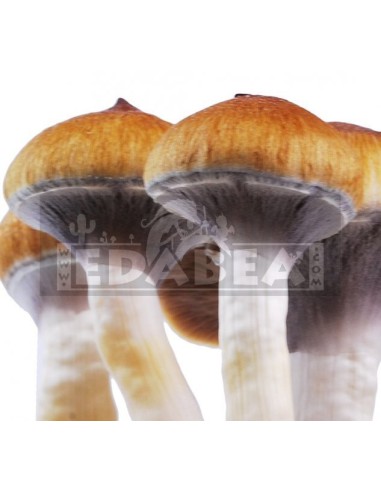
PES Amazonian Spore Vial 10 ml. — Psilocybe cubensis var. PES Amazonian. Spores in a sterile aqueous solution, 10 ml vial with sterile syringe. This strain, originating from the Amazon, is distributed by Pacific Exotica Spora (PES) and is documented as one of the most prolific varieties within P. cubensis: fruiting bodies can exceed 30 cm in height, with meaty caps and thick stems. Production is concentrated in the first two flushes, showing exceptional yield in size. Collection material for mycological research.
PES Amazonian Spore Vial
The PES Amazonian spore vial contains a sterile aqueous suspension of spores from Psilocybe cubensis var. PES Amazonian in a 10 ml vial with included sterile syringe. Like the PES Hawaiian from the catalog, PES stands for Pacific Exotica Spora, the Hawaiian spore distributor who commercialized this strain. The name Amazonian refers to its geographic origin in the Amazon basin, the most documented area of mycological biodiversity on the planet.
Geographic Origin — The Amazon Basin
The Amazon is one of the environments with the highest documented diversity of the genus Psilocybe and of fungi in general. The conditions in the basin—high, constant temperatures, extreme humidity, organic-rich soils, and diffused light under the canopy—provide the optimal habitat for Psilocybe cubensis, a pantropical species that finds some of its most developed morphological expressions in this region.
Psilocybe cubensis was first scientifically described by Cuban-American mycologist Franklin Sumner Earle in 1906 from material collected in Cuba, and later redescribed and renamed by German mycologist Paul Kummer. Its distribution in the Brazilian and Peruvian Amazon has been documented in several field studies from the 20th century, including those by Richard Evans Schultes during his decades of fieldwork in the region.
Documented Morphological Characteristics
- Exceptional Height — documented fruiting bodies of up to 30 cm in height, significantly taller than the average of other P. cubensis varieties. It is one of the tallest growing varieties in the catalog.
- Meaty and Bulbous Caps — the cap is thick and fleshy, with a convex to flattened shape at maturity.
- Thick Stems — robust and firm stems that are well anchored to the substrate, proportional to the overall development of the fruiting body.
- Dense Mycelium — substrate colonization with visibly denser and more covered mycelium than other varieties.
- Concentration of Production in Early Flushes — most of the yield occurs in the first and second flushes, with exceptionally large fruiting bodies particularly in the first flush.
- High Colonization Speed — one of the fastest colonizing varieties in the catalog, alongside the Cambodian.
Vial Characteristics
The vial contains spores of Psilocybe cubensis var. PES Amazonian in a sterile aqueous suspension (10 ml) with an included sterile syringe. Ellipsoid spores with thick walls and standard purplish-brown color for the species, visible from 400x magnification.
To view the full catalog of available varieties, visit the spores section of Edabea.
Conservation
Store in the refrigerator between 2 °C and 8 °C, protected from direct light. Do not freeze. Under proper conditions, the spores maintain viability for months. Avoid abrupt temperature changes between uses.
Legal Situation
The legal status of Psilocybe cubensis spores varies by jurisdiction. In many countries, spores—which do not contain psilocybin or psilocin—are not subject to the same regulations as mycelium or fruiting bodies. It is the buyer's responsibility to verify the applicable regulations in their area before placing an order. This product is marketed exclusively as mycological collection and research material.
Frequently Asked Questions
What is the relationship between PES Amazonian and PES Hawaiian in the catalog?
Both are varieties distributed by Pacific Exotica Spora (PES), the Hawaiian spore distributor active since the 1990s, and share the PES prefix in their name. Beyond the distributor origin, they are morphologically distinct: PES Hawaiian has a morphology similar to that of Golden Teacher with ongoing debate about its taxonomic identity; PES Amazonian is a variety exceptional in height and size, with geographic roots in the Amazon basin. They are two independent references from the same historic distributor.
Why is production higher in the early flushes?
In most P. cubensis varieties, the substrate concentrates its most available nutrients in the early flushes of production. PES Amazonian is documented to maximize this behavior—first and second flushes produce exceptionally sized fruiting bodies, while later flushes tend to reduce both size and quantity. This pattern sets it apart from varieties like Orissa India, whose greatest development occurs in later flushes.
When was Psilocybe cubensis scientifically described?
Psilocybe cubensis was first described in 1906 by mycologist Franklin Sumner Earle from material collected in Cuba, under the name Stropharia cubensis. It was later transferred to the genus Psilocybe by German mycologist Rolf Singer in 1949. The species has a complex taxonomic history with several synonyms—including Stropharia cubensis and Psilocybe subcubensis—reflecting the evolution of knowledge about the genus throughout the 20th century.
Do the spores contain psilocybin?
No. The spores of Psilocybe cubensis do not contain psilocybin or psilocin. These compounds are synthesized during the development of the mycelium and fruiting bodies, not in the spores in their latent state. This distinction is important in many jurisdictions where regulations affect active mycelium and fruiting bodies but not spores.
File prepared by the specialized team at Edabea Natura. Information based on reference mycological bibliography. Last updated: May 2026.
3 Items
Tap to zoom