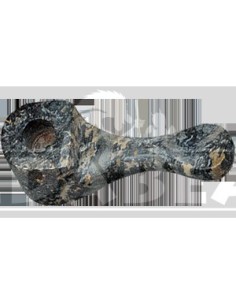
Stone Pipes
Buy Stone Pipes — Selection of Stone Pipes at Edabea
Stone pipes are the most compact and heavy option within the category of smoking pipes. Edabea's stone pipe catalog includes 3 verified references in two formats: a mini of 4.5 cm and two models of 8.5 cm that differ in finish and mouth width. They are the smallest pipes in the catalog and the ones with the highest density by volume. If you are looking for other materials, you can check our categories of glass pipes, wooden pipes, metal pipes, and acrylic pipes, or return to the general pipe category.
Properties of Stone as a Material for Pipes
Density and Weight: Stone is the densest material available in the pipe category. In a mini or compact format, this translates to a solid feel in hand that is very different from acrylic or glass of the same size. The weight is high relative to the volume.
Thermal Conductivity: Stone is a poor conductor of heat, similar to ceramic. The pipe does not heat up as quickly during use as metal, and the temperature at the mouthpiece remains more stable.
Natural Finish: Each stone piece has its own color pattern and veining characteristic of the block of material from which it comes. No two pieces are exactly alike — the finish varies naturally within the same model. The catalog descriptions mention the dominant tone and the presence of veining, but the exact appearance of each piece may differ slightly.
Type of Stone: The type of rock is not specified in the catalog descriptions. We do not declare it.
Durability: Cooked stone is robust for its size but can fracture under strong direct impacts, similar to ceramic. It is more resistant than fine glass to light knocks, but less so than metal or acrylic when dropped on a hard surface.
Available Stone Pipe Models at Edabea
| Model | Length | Finish | Mouth | Distinguishing Feature |
|---|---|---|---|---|
| Mini Stone Pipe | 4.5 cm | — | — | The smallest in the complete pipe catalog — ultra-compact format |
| SP-013 | 8.5 cm | Bluish tone with veining | Wider | Visual finish with veining, bowl with a more generous opening |
| SP-011 | 8.5 cm | Beige without veining | Narrower | Uniform and sober finish, narrower mouth — same length as SP-013 |
Difference between SP-011 and SP-013
Both models have exactly the same length (8.5 cm) and the same compact pipe format. The difference is twofold: finish and mouth width. The SP-013 has a bluish tone with visible veining and a wider mouth, allowing for a bowl with a larger opening. The SP-011 has a uniform beige finish without veining and a narrower mouth. The choice between the two is mainly aesthetic and based on bowl preference.
Cleaning and Maintenance of Stone Pipes
Cleaning stone pipes follows the same principle as ceramic: the interior channel is cleaned mechanically with a pipe cleaner. The 15 cm cleaners available in our pipes accessories section are suitable for the 8.5 cm models, although for the mini 4.5 cm, it may be necessary to bend the cleaner or use a finer swab due to the small size of the channel.
For resin residues in the bowl, the most practical method is mechanical removal with a fine-tipped tool without solvents. Isopropyl alcohol does not damage the stone in principle, but since the type of rock is not specified in the descriptions, we cannot confirm its compatibility with certainty — caution is recommended when using solvents on these models.
Frequently Asked Questions about Stone Pipes
What differences do stone pipes have compared to ceramic ones?
They share several physical properties — low thermal conductivity, high density, opaque finish — but there are relevant differences. Ceramic is a manufactured material (cooked and glazed clay) that allows for more complex shapes and controlled glazed finishes. Stone is a naturally carved material whose finish depends on the veining and color inherent to the block. Stone is generally denser than ceramic for the same volume. The glaze of ceramic is compatible with isopropyl alcohol; we do not specify stone compatibility because the type of rock is not specified.
Are stone pipes resistant to impacts?
They are more robust than fine glass against light impacts, but less resistant than metal or acrylic against direct impacts or drops onto hard surfaces. Their greater density gives them a solid feel, but stone can fracture from a strong blow just like ceramic or glass. If impact resistance is the priority criterion, metal pipes are the most suitable option.
What is the difference between SP-011 and SP-013?
They have the same length (8.5 cm) and the same format. The SP-013 has a bluish finish with visible natural veining and a wider mouth — larger bowl opening. The SP-011 has a uniform beige finish without veining and a narrower mouth. The difference is aesthetic and based on bowl preference: if a more striking finish and an open bowl are desired, the SP-013; if a more understated finish and a compact mouth are preferred, the SP-011.
What type of stone is it?
The type of rock is not specified in the catalog descriptions. We do not declare it because we do not have the information with verifiable certainty. If you need this information for your purchase, you can reach out to us directly at contacto@edabea.com.
How do you clean a stone pipe?
The interior channel is cleaned with a pipe cleaner — available in our accessories section. For the mini 4.5 cm, a finer swab may be needed due to the reduced channel size. Residue from the bowl is mechanically removed without solvents. We do not recommend isopropyl alcohol for these models because the type of stone is not specified, and we cannot confirm its compatibility.
Selection made by the Edabea team. Last updated: April 2026. For inquiries about availability or features of a specific model, contact at contacto@edabea.com.
Feedbacks