

Shopping Cart
There are no more items in your cart
Myths and realities of hallucinogenic mushrooms and other psychedelic substances
Categories :
Mushrooms
Hallucinogenic mushrooms and other psychedelic substances generate curiosity, fear, and many exaggerated stories. Between urban legends and alarmist headlines, it is easy to get lost, which is why it is essential to separate myths about hallucinogenic mushrooms from facts that are backed by evidence.
What we mean by hallucinogenic mushrooms and psychedelic substances
When we talk about hallucinogenic mushrooms, we are usually referring to fungi that contain psilocybin and psilocin, two compounds that alter perception, mood and thinking. All kinds of stories have emerged around them, from almost mystical experiences to horror stories, fuelling a highly distorted image of their real effects.
In addition to mushrooms, there are other psychedelic substances such as LSD, mescaline, DMT and synthetic derivatives. Each one acts differently and has its own risk profile, but they are often lumped together. At Edabea, we see this every day: many people confuse ‘psychedelic’ with “harmless” or ‘safe poison,’ when the reality is much more nuanced.
Why are there so many myths about hallucinogenic mushrooms?
Some of the myths stem from sensationalism: extreme news stories that go viral, films where everything goes wrong, or stories told by ‘a friend of a friend’. Others come from silence: for decades, the subject has been little discussed and poorly addressed, leaving room for incomplete information, unfounded opinions and dangerous advice.
In our case, at Edabea we are clear: we do not encourage the consumption of mushrooms or any other psychedelics. We focus on the ornamental, botanical and collectible aspects, and on providing information so that those interested in these species can better understand the context, the risks and the legal framework.
Common myths about hallucinogenic mushrooms
When discussing myths about hallucinogenic mushrooms, it is best to debunk them one by one. Many people mix real facts with erroneous conclusions, which can lead to poorly informed decisions and unrealistic expectations.
Myth 1: ‘They are natural, so they are 100% safe’
The argument that ‘if it's natural, it can't hurt you’ is constantly repeated. However, there are natural plants and fungi that are deadly. Just because a mushroom grows in a meadow does not make it a toy. What is true is that psilocybin is being researched in highly controlled clinical settings, but that does not mean that recreational use, without supervision, is safe or advisable.
At Edabea, we always emphasise this idea: natural does not mean risk-free. Even if psilocybin mushrooms are not consumed, simply handling species without knowing how to identify them can lead to confusion with other toxic mushrooms.
Myth 2: ‘Mushrooms do not cause long-term problems’
Another widespread myth is that hallucinogenic mushrooms ‘leave no trace’ because they do not cause classic physical addiction. It is true that psilocybin is not associated with the withdrawal symptoms typical of other drugs, but that does not mean that there cannot be significant psychological or emotional consequences.
In vulnerable individuals with a history of mental health problems or undergoing certain treatments, an intense experience can trigger episodes of severe anxiety, depersonalisation or psychotic episodes. Therefore, minimising the long-term risks is as dangerous as exaggerating them.
Myth 3: ‘With a small dose, everything is mild and controllable.’
The idea that ‘nothing bad can happen with a small amount’ is misleading. The intensity of the effects depends not only on the amount, but also on the species, the person's state of mind, the environment, and other biological factors. Even with low amounts, some people report very uncomfortable experiences. There is no universally ‘safe’ dose for everyone.
Furthermore, in an unregulated environment, it is difficult to know what you are actually taking. Different batches or species can have very different concentrations. Therefore, simplistic messages such as ‘a small dose is always mild’ are, at best, incomplete.
Myth 4: ‘You can't have a bad trip with mushrooms’
It is also said that trips with mushrooms are ‘kinder’ than with other substances. The reality is that, although many people describe positive experiences, there is no shortage of stories of intense fear, confusion or feelings of losing control. A ‘bad trip’ is not an invention, and can be a very distressing experience even if there is no direct physical harm.
We often emphasise to our clients that idealising any psychedelic as something “only beautiful” is a form of misinformation. The same substance that is inspiring to some can be overwhelming to others, and that unpredictability is precisely one of the great risks.
Myth 5: “Mushrooms show you the absolute truth”
Some people talk about mushrooms as a direct path to ‘the truth of the universe’ or a kind of guaranteed enlightenment. It is true that many people report changes in perspective, deep introspection, or feelings of connection. But that does not make the experience an unquestionable oracle or a spiritual shortcut.
Psychedelic experiences are subjective, filtered through each person's personal history, beliefs, and expectations. At Edabea, we often emphasise that intense experiences are not necessarily objective truths, and that clinging to them as dogma can complicate subsequent integration.
Myth 6: ‘They only affect the brain, not the body’
Another common misconception is that psychedelics are ‘gentle on the body.’ Although the focus is on mental effects, physical changes are also observed: increased heart rate, changes in blood pressure, nausea or gastrointestinal discomfort, among others. To say that mushrooms only affect the mind is to ignore part of the picture.
In people with cardiovascular problems, specific medication or other conditions, these changes can be particularly significant. Again, the absence of visible problems in some people does not mean that the risk is zero for everyone.
Myth 7: ‘If they are legal somewhere, there is no problem here’
The legality of mushrooms and other psychedelic substances varies greatly from country to country and even from region to region. Just because a substance is tolerated or regulated in one place does not mean it is in yours. Globally, psilocybin remains controlled in most legal frameworks, which means possible criminal consequences for production, possession or consumption.
At Edabea, we make it very clear: our products are not intended for human consumption or illegal use. They are intended for collection, botanical study or decoration. Each person is responsible for knowing and respecting the regulations of their country before purchasing or handling any species.
Facts about psychedelic effects
Beyond the myths, we can talk about some general realities regarding psychedelic substances. The most widely accepted view today is that they produce temporary changes in brain activity related to perception, imagination, and the way different areas of the brain connect. This translates into sensory alterations, changes in the perception of time, and intense emotions.
We also know that context matters: physical and emotional state (set) and environment (setting) greatly influence how the experience is lived. This does not make the situation 100% controllable, but it helps to understand why two people can react very differently to the same substance.
Real dangers: truth or myth
When it comes to the dangers of psychedelics, some warnings are exaggerated, but others fall short. The key is to differentiate between what has been repeated without evidence and the risks that are consistently described in scientific literature. Neither ‘they are pure poison’ nor ‘nothing will happen’ are realistic statements.
Among the best-documented risks are episodes of extreme anxiety, psychotic reactions in predisposed individuals, accidents due to impaired judgement or coordination, and interactions with other drugs or substances. Added to this are legal risks. Taken together, these factors mean that unsupervised recreational use cannot be considered a safe practice, however normalised it may seem in some circles.
What about addiction?
It is sometimes claimed that psychedelics are ‘non-addictive’ and contrasted with other drugs. It is true that their pattern of use tends to be different and that they do not generate typical physical dependence, but problematic use or seeking increasingly intense experiences as a form of escape can occur.
We emphasise to our clients that reducing the conversation to ‘addictive/non-addictive’ is oversimplifying the issue. The focus should be on the fact that any use that negatively affects one's personal, social or emotional life is a problem, even if there is no physical withdrawal.
Hallucinogenic mushrooms versus other psychedelics
Another common misconception is that all psychedelic substances are ‘more or less the same.’ In reality, there are important differences in duration, subjective intensity, and effect profile. For example, a trip on mushrooms is often described as more organic or “earthy” compared to other synthetic compounds, while substances such as LSD are associated with longer and sometimes more stimulating experiences.
In addition, substances such as DMT or ayahuasca are characterised by very brief but extremely intense experiences in the case of the former, or by complex rituals accompanied by vomiting and physical discomfort in the case of the latter. Grouping everything together as ‘psychedelics’ without distinction means that we lose sight of the fact that each compound has a different risk and context.
Get informed without putting your health at risk
For many people, their first contact with these substances is through forums, social media or friends. The problem is that these spaces mix real experiences, covert advertising and unfounded advice. That is why it is so important to seek verified information, understand the risks and know the legal context before making any decisions.
At Edabea, we take the educational approach very seriously. In our case, we prefer to emphasise that learning about these species does not imply consuming them. You can take an interest in their biology, cultural history or role in scientific research without crossing legal or health boundaries.
Mushrooms as objects of study, collecting and ornamental cultivation
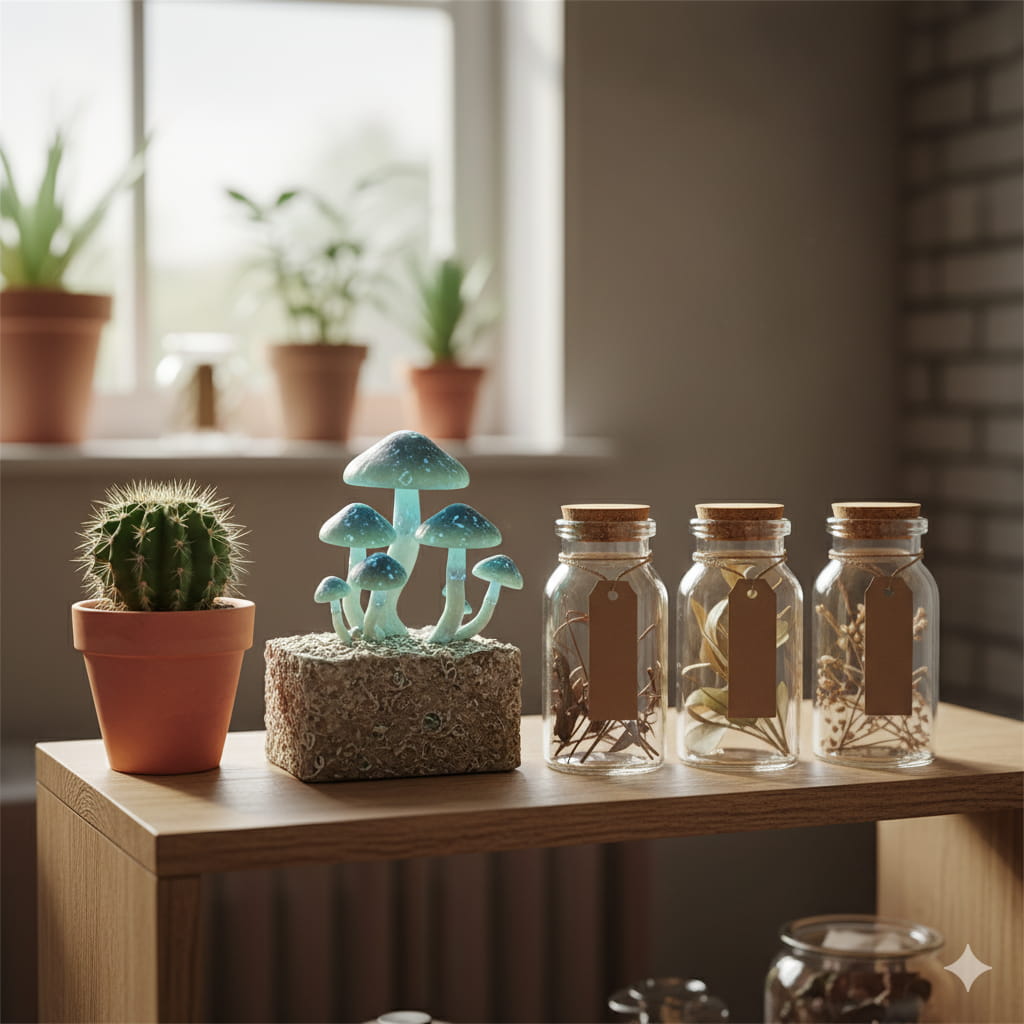
Beyond recreational use, psilocybin mushrooms attract attention for their diversity and biology. Some people enjoy them from a mycological perspective, as objects of study or as part of a collection. For this profile, the priority is to access quality material and have a good understanding of the legal framework in their country.
If you are interested in the variety of species available for collection, you can take a look at our hallucinogenic mushroom catalogue , always bearing in mind that our products are not intended for human consumption and that you must comply with local regulations.
We often emphasise to our customers that curiosity about hallucinogenic mushrooms can be satisfied in many ways: by reading studies, learning about species, caring for kits at an ornamental level, or delving into their cultural symbolism.
How to continue learning responsibly

If you are beginning to take an interest in mycology related to psilocybin mushrooms, it is best to take it step by step. Combining reliable sources, specialised literature and the experiences of responsible growers helps to build a more complete and less sensationalist view of hallucinogenic mushrooms.
On the Edabea blog, we share content designed specifically for those who are approaching this field for the first time out of curiosity and respect. A good introduction is our guide to my first mushroom kit, aimed at those who want to better understand how these kits work on a practical and ornamental level, without going into recommendations for consumption.
In summary, hallucinogenic mushrooms and other psychedelic substances are neither demons nor harmless toys. Between the extremes there is a space for nuance where curiosity, study and respect can fit.
Share this content