

Shopping Cart
There are no more items in your cart
Differences Between Leaves and Extracts of Salvia Divinorum
Categories :
Salvia Divinorum
Within Edabea's Salvia divinorum catalog, two formats of plant material coexist: dried leaves and concentrated extracts. Both come from the same botanical species – Salvia divinorum Epling & Játiva-M., from the Lamiaceae family – but differ in the degree of processing of the plant material and, consequently, in the concentration of its main active phytochemical compound: salvinorin A. This article describes the technical differences between both formats, the process of extracting the extracts, and the verified analytical data of each concentration level available in the catalog. For a complete botanical and historical context of the species, you can consult our article on Salvia divinorum; for a detailed description of the active compound, the article on what salvinorin A is.

Salvia divinorum Epling & Játiva-M. — fresh leaves with the characteristic central vein of the species. Family Lamiaceae.
Salvinorin A: The Benchmark Compound
Salvinorin A (C23H28O8) is the neoclerodane diterpenoid responsible for the pharmacological activity of Salvia divinorum. It was first isolated and identified by Valdés, Diaz, and Paul in 1984 (Valdés, L.J. et al., 1984. Journal of Organic Chemistry, 49(24), 4716–4720). Unlike most known plant psychoactive compounds, salvinorin A is not an alkaloid — it is a terpenoid — and acts as a potent and selective agonist of kappa opioid receptors (KOR), with no significant affinity for the serotoninergic 5-HT2A receptors that define classic psychedelics like psilocybin or DMT (Roth, B.L. et al., 2002. PNAS, 99(18), 11934–11939).
In the dried leaves of Salvia divinorum, the natural concentration of salvinorin A ranges approximately between 0.89 and 3.87 mg per gram of dry material, with a documented average of around 2.5 mg/g (Valdés, L.J. et al., 1994. Journal of Ethnopharmacology, 43(3), 171–179). This variability depends on geographical origin, cultivation conditions, harvest time, and drying process.
The Dried Leaves: Unconcentrated Plant Material
The dried leaves of Salvia divinorum are the dehydrated plant material with no additional concentration process. They retain the original phytochemical composition of the species: salvinorin A in its natural concentration, along with the other compounds present in the leaf — salvinorin B, saponins, flavonoids, and other secondary terpenoids documented in specialized literature.
The dried leaf format is the closest to the material originally used historically in the ceremonial contexts of the Mazatecs of Oaxaca (Mexico), documented by Wasson (1962) and Valdés et al. (1994). It is also the format with the greatest phytochemical richness in terms of compound variety, although with a lower concentration of salvinorin A per gram compared to any of the available extracts.

Dried leaves of Salvia divinorum. The natural concentration of salvinorin A in the dried leaf ranges from 0.89 to 3.87 mg/g depending on origin and batch.
The Extracts: Concentration Process and Technical Basis
The extracts of Salvia divinorum are obtained through an extraction process of salvinorin A from the original plant material, followed by its reapplication in larger proportion to a plant base. The most common process uses high-purity organic solvents — acetone or isopropyl alcohol — which selectively dissolve salvinorin A and other lipophilic terpenoids from the leaf, separating them from the rest of the plant matrix by differences in solubility. The extract obtained is evaporated to dryness and reapplied to inert plant material or leaf base in the desired proportion.
The result is a material with a concentration of salvinorin A per gram significantly higher than the original leaf, standardized to a specific level expressed through the X scale. The nomenclature of the X scale indicates the theoretical concentration relationship compared to the starting leaf: a 5X extract has approximately five times more salvinorin A per gram than standard leaf; a 20X extract, approximately twenty times more.

Extraction process with organic solvent from Salvia divinorum plant material. The rotary evaporator removes the solvent to obtain the concentrated extract.
Available Extract Scale at Edabea — Verified Analytical Data
Edabea’s extract catalog covers six concentration levels, from 5X to 80X, with the approximate concentration of salvinorin A per gram verified in the product sheet:
| Extract | Salvinorin A (mg/g) | Format | Sheet |
|---|---|---|---|
| 5X Extract | ~12.5 mg/g | 1 g | View |
| 10X Extract | ~25 mg/g | 1 g | View |
| 20X Extract | ~50 mg/g | 1 g | View |
| 30X Extract | ~75 mg/g | 0.5 g | View |
| 40X Extract | ~100 mg/g | 0.5 g | View |
| 80X Extract | ~288 mg/g | 0.5 g | View |
The concentration of the 80X extract (~288 mg/g) represents approximately double that of the 40X extract (~100 mg/g) and nearly 23 times more salvinorin A per gram than the documented average concentration in the dried leaf (~12.5 mg/g based on the lower end of the natural range). For those wanting to study the complete range in one format, the complete pack of extracts includes all available concentrations.
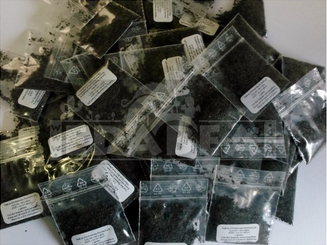
Standardized extracts of Salvia divinorum from Edabea's catalog — scale 5X (≈12.5 mg/g of salvinorin A) to 80X (≈288 mg/g). Botanical collection material and ethnobotanical research.
Technical Comparison: Leaves vs Extracts
| Aspect | Dried Leaves | Extracts (5X–80X) |
|---|---|---|
| Salvinorin A concentration | ~0.89–3.87 mg/g (natural, variable) | ~12.5–288 mg/g (standardized) |
| Processing | Dehydration only | Solvent extraction + reapplication to plant base |
| Phytochemical profile | Complete (salvinorin A + B, saponins, flavonoids, other terpenoids) | Concentrated in salvinorin A on inert or leaf base |
| Standardization | No — variable concentration between batches and origins | Yes — fixed concentration per extract level |
| Available format | Loose dried leaf | Fine powder in 1 g (5X–20X) or 0.5 g (30X–80X) |
| Historical reference | Documented Mazatec traditional use | Modern laboratory format |
The X Scale and Its Limitations as a Concentration Measure
The X scale is a relative, not absolute measure. It indicates the theoretical concentration relationship compared to the starting plant material, but the final result in mg/g depends on the actual concentration of salvinorin A in the leaf of origin. Since the natural concentration in the leaf varies between 0.89 and 3.87 mg/g according to the available literature, a “5X” extract made from leaf with 1 mg/g of salvinorin A will not have the same absolute concentration as one made from leaf with 3.5 mg/g.
For this reason, the extracts in the Edabea catalog indicate the approximate concentration of salvinorin A in mg/g in each product sheet — a more precise piece of data for comparison between formats than the relative scale.
Conservation
Both the leaves and the extracts must be kept in airtight containers, in a cool, dry place, protected from direct light and heat. Salvinorin A is relatively stable under proper storage conditions, but prolonged exposure to light, heat, and humidity can degrade the material and reduce its concentration. The extracts, due to their higher concentration per unit of volume, are especially sensitive to these conditions.
Legal Situation
Salvinorin A is included in the lists of controlled substances in various jurisdictions. It is the responsibility of the buyer to verify the applicable regulations in their place of residence before placing an order. This product is marketed exclusively as botanical collection material and ethnobotanical research.
Frequently Asked Questions
What is salvinorin A and why is it relevant in this context?
Salvinorin A is the neoclerodane diterpenoid responsible for the pharmacological activity of Salvia divinorum. It was identified in 1984 and is the benchmark compound for the characterization and standardization of the plant's extracts. Unlike most known plant psychoactive compounds, it is not an alkaloid but a terpenoid, and selectively acts on kappa opioid receptors in the central nervous system, a unique mechanism in naturally occurring psychoactive compounds studied (Roth, B.L. et al., 2002, op. cit.).
How is an extract of Salvia divinorum made?
Through extraction with organic solvent — usually acetone or high-purity isopropyl alcohol — which selectively dissolves salvinorin A and other lipophilic terpenoids from the leaf. The extract is evaporated to dryness and reapplied to a plant base in the proportion corresponding to the desired concentration level (5X, 10X, 20X, etc.). The process removes much of the rest of the plant matrix — flavonoids, chlorophylls, and other terpenoids — concentrating primarily on salvinorin A in the resulting material.
Why is the X scale not an exact measure of concentration?
Because it is a relative measure that depends on the concentration of salvinorin A in the base leaf material, which varies naturally between 0.89 and 3.87 mg/g according to origin and batch. A 5X extract made from low-concentration leaves will have less salvinorin A per gram than one made from high-concentration leaves. Therefore, Edabea's extracts include the approximate concentration in mg/g in each product sheet.
Does the 80X extract contain exactly 80 times more salvinorin A than the leaf?
Not necessarily in absolute terms. The 80X extract from Edabea’s catalog contains approximately 288 mg of salvinorin A per gram. Based on the average concentration of the dried leaf (~2.5 mg/g), the ratio would be approximately 115 times. Taking the lower limit of the natural range (~0.89 mg/g), the ratio would be ~323 times. The designation 80X is an indication of the relative level of concentration within the commercial scale, not an exact dilution data.
Where can I see all available formats?
You can check the category of Salvia divinorum leaves and the category of extracts to compare all the available formats. To study the complete scale of extracts, the extract pack includes all concentrations in a single purchase.
About This Content
Article created by the specialized team at Edabea Natura, with more than 15 years of experience in the selection and marketing of ethnobotanical materials. The phytochemical information is based on the cited bibliographic sources. The concentration data of salvinorin A in mg/g correspond to the values indicated in the product sheets of Edabea's catalog. Last update: April 2026.
Bibliographic References
- Roth, B.L. et al. (2002). Salvinorin A: a potent naturally occurring nonnitrogenous kappa opioid selective agonist. PNAS, 99(18), 11934–11939.
- Valdés, L.J. et al. (1984). Divinorin A, a psychotropic terpenoid, and divinorin B from the hallucinogenic Mexican mint Salvia divinorum. Journal of Organic Chemistry, 49(24), 4716–4720.
- Valdés, L.J. et al. (1994). Ethnopharmacology of ska María Pastora (Salvia divinorum). Journal of Ethnopharmacology, 43(3), 171–179.
- Wasson, R.G. (1962). A new Mexican psychotropic drug from the mint family. Botanical Museum Leaflets, Harvard, 20(3), 77–84.
Share this content