Shopping Cart
There are no more items in your cart


PES Hawaiian 10 ml.
Last items in stock
€14.50
Tax included
PES Hawaiian Spore Vial 10 ml. — Psilocybe cubensis var. PES Hawaiian. Spores in sterile aqueous solution, 10 ml vial with sterile syringe. The name PES Hawaiian refers to the Hawaiian spore distributor Pacific Exotica Spora — the actual geographic origin of the strain is not Hawaii. One of the historically most present varieties in the collectible market of P. cubensis, with morphology similar to the Golden Teacher and documented debate in the mycological community regarding its taxonomic relationship to that variety. Collection material for fungal research.
Ratings and comments from our customers
PES Hawaiian Spore Vial
The PES Hawaiian spore vial contains a sterile aqueous suspension of Psilocybe cubensis var. PES Hawaiian in a 10 ml vial with an included sterile syringe. It is one of the historically most prominent varieties in the European collectible market for P. cubensis and has generated significant debate about its taxonomic identity within the specialized mycological community.
Origin of the Name — Pacific Exotica Spora
The name PES Hawaiian does not refer to a geographic origin in Hawaii. The acronym PES stands for Pacific Exotica Spora, a specialized mycology spore distributor based in Hawaii since the 90s that marketed this strain under that name. The actual geographic origin of the variety is not precisely documented, and it is possible that the term "Hawaiian" refers more to the place of distribution than to isolation.
This distinction between commercial name and actual geographic origin is relevant for collectors working with provenance traceability — the PES Hawaiian is a catalog name with documented commercial history, not a strain of verifiable Hawaiian geographic origin.
Relationship with the Golden Teacher Variety
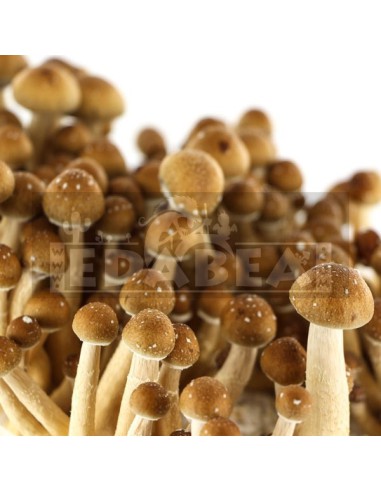
There is an unresolved debate in the specialized mycological community regarding the relationship between PES Hawaiian and Golden Teacher, another highly distributed variety in the P. cubensis catalog. Both share remarkable morphological characteristics — golden to light brown cap, medium-large fruiting bodies, and generally similar morphology — leading some collectors and researchers to suggest they could be the same strain under different names, or closely related lines derived from the same source material.
As of now, no published genetic characterization has definitively resolved this question, making PES Hawaiian a case of interest for those working in molecular taxonomy of P. cubensis varieties.
Documented Morphological Characteristics
- Golden to light brown cap — characteristic color tone shared with the Golden Teacher, distinguishing it from darker varieties like Mazatapec or Red Boy.
- Medium-large fruiting bodies — robust cap development, with a diameter exceeding the average for the species.
- Stable overall morphology — regular production with little variability between flows, a characteristic shared with other historically well-established varieties.
Vial Characteristics
The vial contains spores of Psilocybe cubensis var. PES Hawaiian in sterile aqueous suspension (10 ml) with an included sterile syringe. Ellipsoid spores with thick walls and standard purplish-brown color for the species, visible from 400x magnification.
To consult the complete catalog of available varieties, visit the spore section of Edabea.
Storage
Store in the refrigerator between 2 °C and 8 °C, protected from direct light. Do not freeze. Under proper conditions, the spores maintain their viability for months. Avoid sudden temperature changes between uses.
Legal Situation
The legal situation of Psilocybe cubensis spores varies by jurisdiction. In many countries, spores — which do not contain psilocybin or psilocine — are not subject to the same regulations as mycelium or fruiting bodies. It is the buyer's responsibility to verify the applicable regulations in their place of residence before placing an order. This product is marketed solely as mycological collection and research material.
Frequently Asked Questions
Does PES Hawaiian actually come from Hawaii?
Not necessarily. The name refers to Pacific Exotica Spora, the Hawaiian spore distributor that marketed this strain, not to a documented geographic origin in Hawaii. The original isolation location of the variety is not specified in the available documentation, which is common in commercially distributed P. cubensis varieties since the 90s, whose provenance traceability is often incomplete or based on oral tradition within the collector community.
Is PES Hawaiian the same strain as Golden Teacher?
This is unresolved. They share similar morphology — golden cap color, medium-large size, stable behavior among flows — and there are collectors who consider them to be the same strain under different names. However, there is no published genetic characterization confirming or disproving this hypothesis. From a collection perspective, they are two distinct references with independent commercial histories, and their direct comparison in microscopy or culturing is one of the documentation tasks that this variety may motivate.
Do the spores contain psilocybin?
No. The spores of Psilocybe cubensis do not contain psilocybin or psilocine. These compounds are synthesized during the development of the mycelium and the fruiting bodies, not in the latent spores. This distinction is relevant in many jurisdictions where the regulation affects active mycelium and fruiting bodies but not the spores.
Profile prepared by the specialized team at Edabea Natura. Information based on reference mycological bibliography. Last update: May 2026.
1 Item
Tap to zoom