

Shopping Cart
There are no more items in your cart
How Kratom is Processed
Categories :
Kratom
Harvesting, Drying, Fermentation, and Grinding
The processing of Mitragyna speciosa leaves after harvesting is the primary factor that determines the commercial classification of kratom by vein color and the alkaloid profile of the resulting material. From harvesting to final grinding, each step of the process influences the chemical composition of the powder or cut leaves that reaches the market. This article describes each phase of the process with available bibliographic support. For the complete ethnobotanical and historical context of the plant, check out our comprehensive guide on kratom. For a detailed description of the main alkaloid, see the article on what mitragynine is.
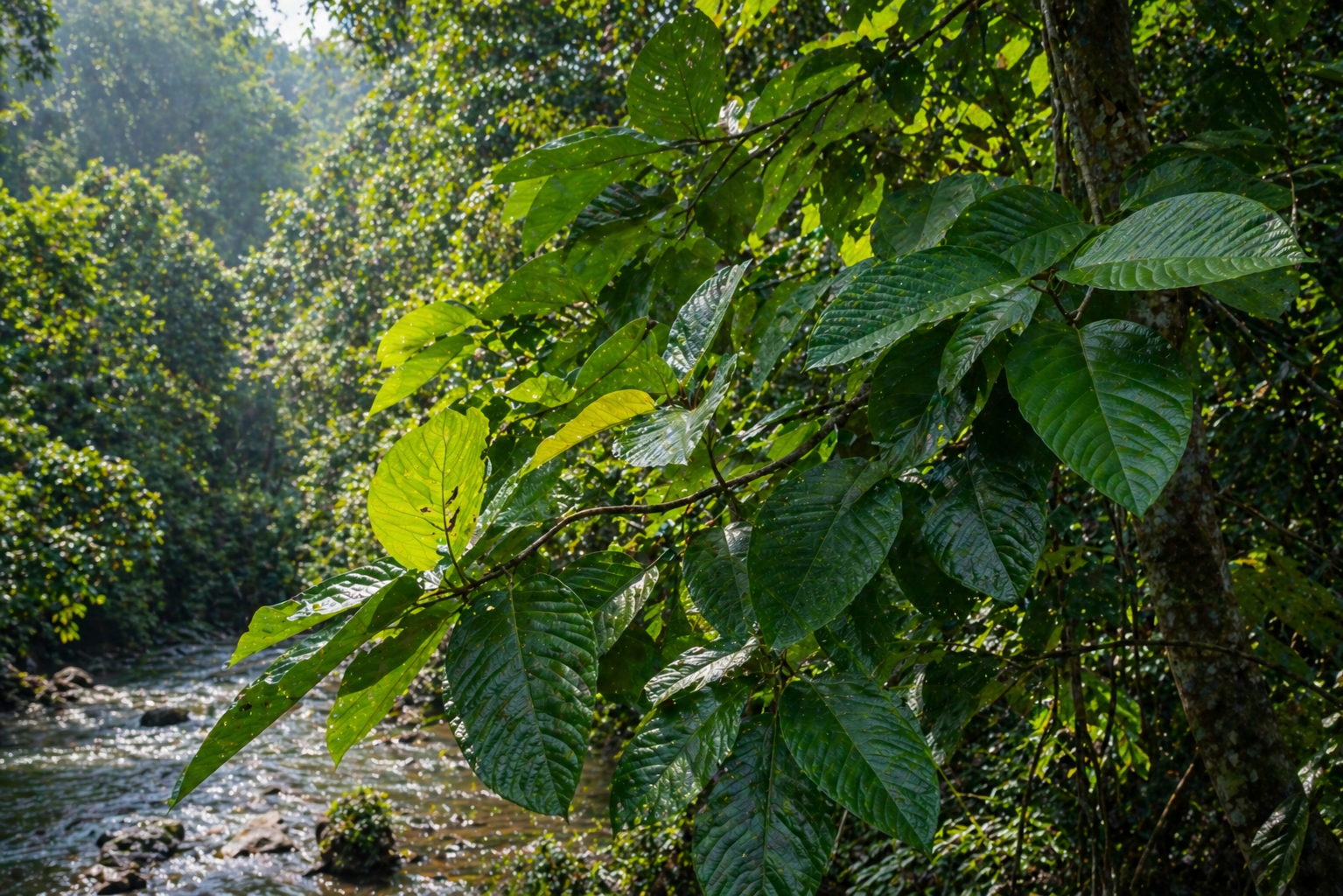
Mitragyna speciosa in its natural habitat — riverbank in tropical forest of Borneo
Harvesting the Leaves
The leaves of Mitragyna speciosa are hand-harvested from plantations or wild trees in producing regions — mainly Kalimantan (Indonesian Borneo), Sumatra, Java, and some areas of Thailand and Malaysia. Harvesting typically occurs in the early morning hours when leaf turgor is at its maximum and the water content of the leaf favors more uniform subsequent drying.
The maturity of the leaf at the time of harvest is relevant to the alkaloid profile: mature leaves generally have a higher concentration of mitragynine than younger ones. The commercial terms "Maeng Da" and "Super" refer specifically to criteria for leaf selection — mature selected leaves and leaves from the top position of the tree, respectively — although they do not correspond to distinct species or botanical varieties (Shellard, E.J. et al., 1978. Planta Medica, 34(3), 253–263).
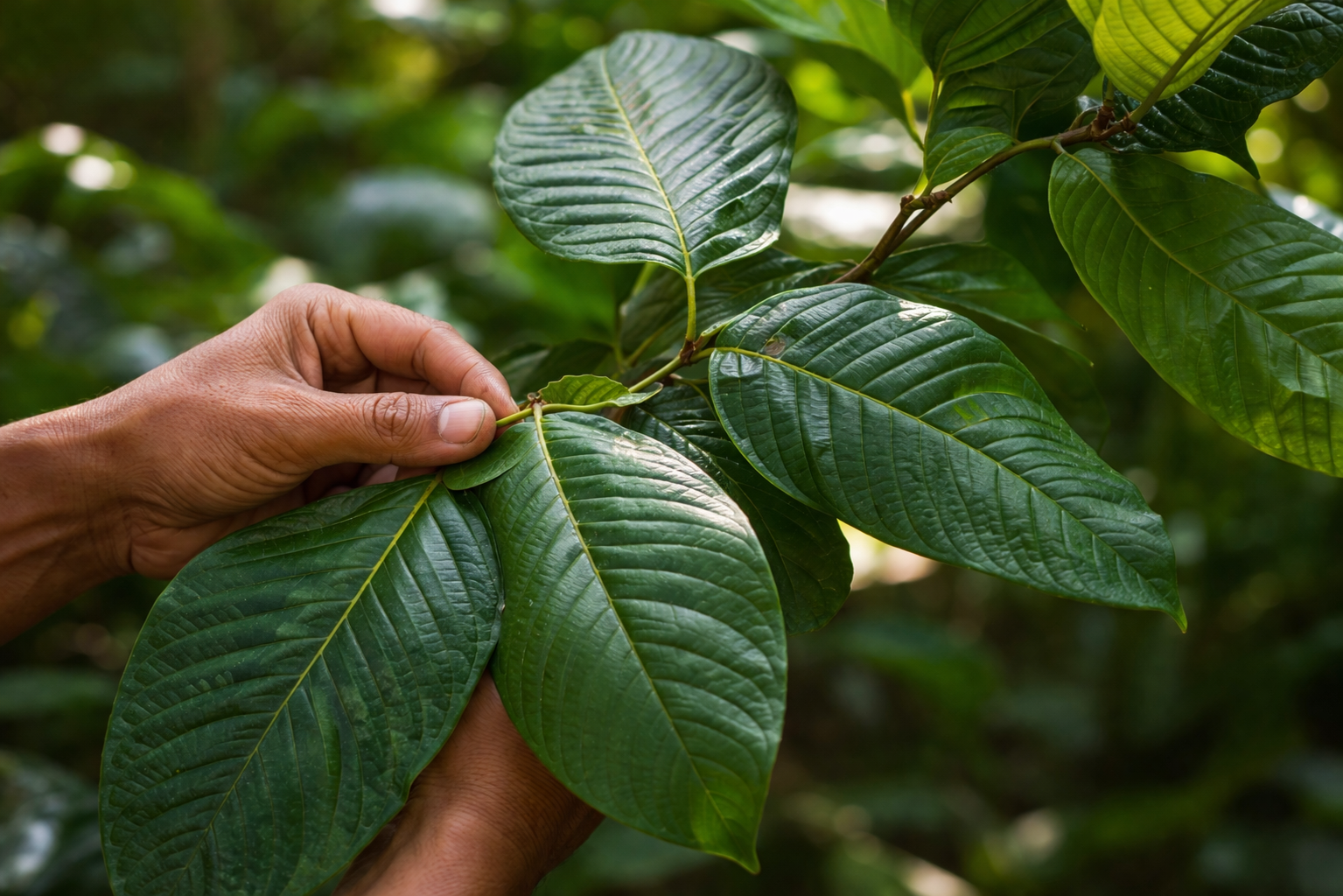
Manual selection of mature Mitragyna speciosa leaves in plantation
Drying — the Determining Phase for Vein Color
Drying is the stage that most directly determines the commercial classification of the material by vein color. Variations in the method, duration, and conditions of drying produce documented differences in the alkaloid profile of the resulting material, particularly in the relative proportion of mitragynine and other minor alkaloids (Veltri, C. & Grundmann, O., 2019. Substance Abuse and Rehabilitation, 10, 23–35).
Red Vein — prolonged sun-drying: the leaves are spread in the sun for a longer period, favoring the oxidation of some compounds and the partial degradation of chlorophyll, producing the characteristic dark color. The oxidation process can modify the relative proportion of alkaloids compared to fresh material.
Green Vein — mixed drying: combination of indoor and outdoor phases, with less accumulated exposure to light and less degree of oxidation than red vein. Produces material with an alkaloid profile intermediate between white and red vein.
White Vein — indoor drying: the leaves are dried under less exposure to light and with controlled temperature and humidity. The shorter process with less oxidation produces the lightest colored material in the standard catalog.
Yellow Vein — differentiated post-harvest process: the term "yellow vein" does not correspond to a real botanical vein of the Mitragyna speciosa leaf. It is the result of a differentiated post-harvest process — prolonged curing, mixing materials from different veins or controlled fermentation — that produces material with its own organoleptic and phytochemical characteristics. Its denomination is commercial, not botanical.
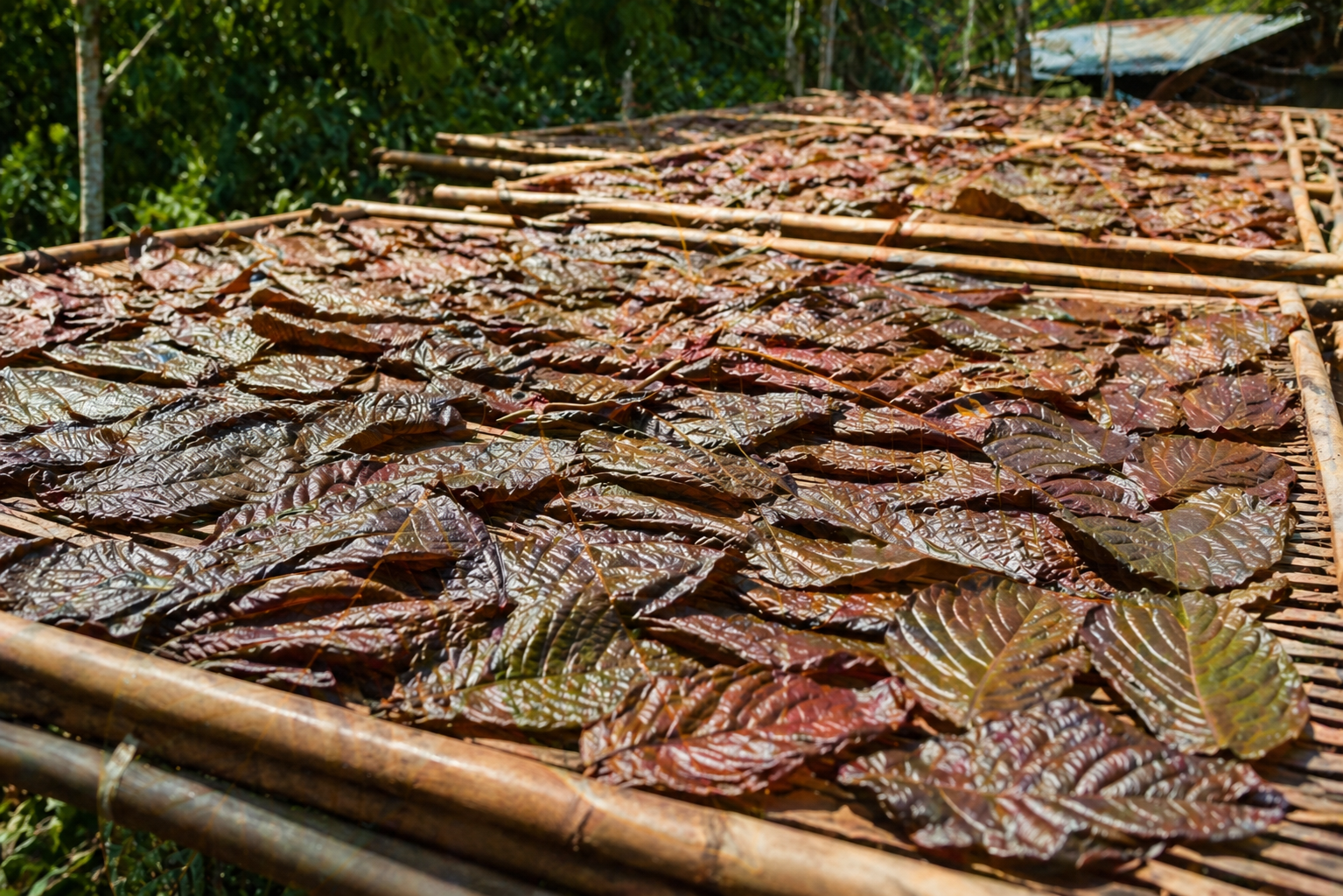
Mitragyna speciosa leaves undergoing sun drying on bamboo racks — obtaining red vein
Fermentation — Optional Process
Some producers apply a controlled fermentation process before or during final drying. Fermentation — exposing the moist plant material to conditions that favor microbial and enzymatic activity for a certain period — modifies the alkaloid profile by transforming some precursor compounds into others. This process can alter the leaf color toward darker or yellowish shades, and is one of the techniques that results in material classified as yellow vein.
Fermentation is not universal in the production of Mitragyna speciosa and depends on the local tradition of the producer or the desired product strategy. Not all materials labeled as "yellow vein" have undergone fermentation — some are simply mixtures of veins or materials with prolonged curing.
Grinding and Final Format
Once dried, the leaves are crushed to obtain the desired commercial format. The two main formats in the Edabea catalog are:
Fine Powder: the dried leaves are ground to produce a fine, uniform powder. It is the most common format in the catalog, available in packs of 25 g and 100 g. Fine grinding produces a homogeneous powder with a larger contact surface, favoring the extraction of alkaloids in infusion.
Cut Leaf: the leaves are crushed to a coarser granularity, preserving larger fragments. This format better preserves the original plant structure and has a smaller surface area exposed to air, potentially slowing oxidation during storage. Available in the Thai Supreme and Maeng Da references in the Edabea catalog.
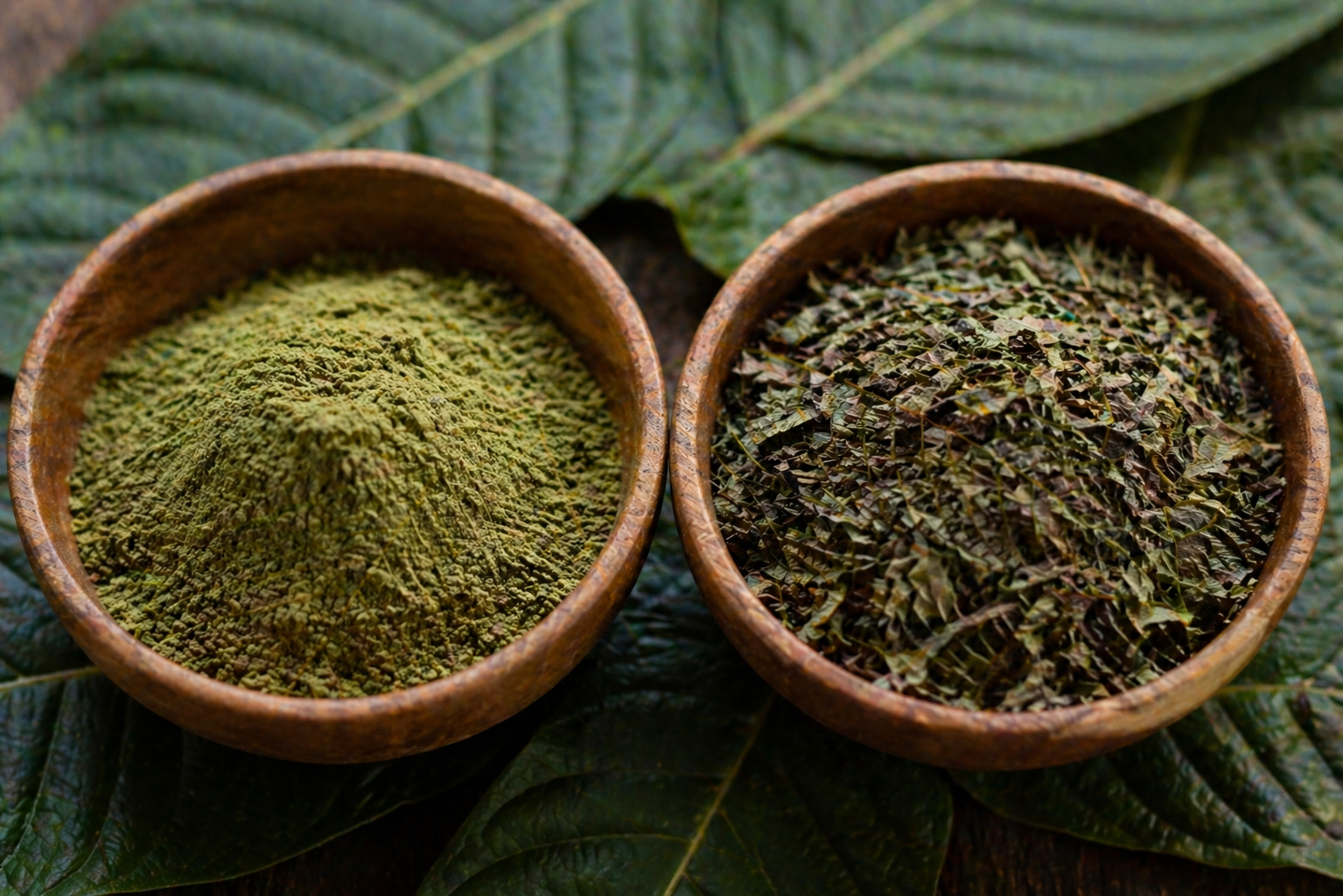
Fine powder and cut leaf of Mitragyna speciosa — the two main formats in the Edabea catalog
Impact of Processing on Phytochemical Profile
The set of processing decisions — harvest timing, drying method, optional fermentation, and grinding granularity — determines the final alkaloid profile of the material. Data from batch 22,885 of the Edabea catalog illustrate the variability between varieties subjected to different processes: Green Maeng Da (green drying, selected mature leaves) recorded 1.37% mitragynine and 1.98% total alkaloids; White Bali (white drying, Bali) recorded 1.22% mitragynine and 1.88% total, in UHPLC-DAD laboratory analysis ISO 17025 (ref. L440, October 2025).
This documented variability between batches and varieties is the reason why Edabea subjects each new batch to laboratory analysis before incorporating it into the catalog, rather than assuming the alkaloid profile of an origin or denomination is consistent across harvests.
Storage of Processed Material
Kratom in powder and cut leaf form should be stored in airtight packaging, protected from moisture, direct light, and heat. The powder is especially susceptible to environmental moisture absorption, which can alter its texture and promote microbial development. Prolonged exposure to UV light and high temperatures accelerates the degradation of indole alkaloids. Proper storage preserves the stability of the alkaloid profile during the batch's validity period.
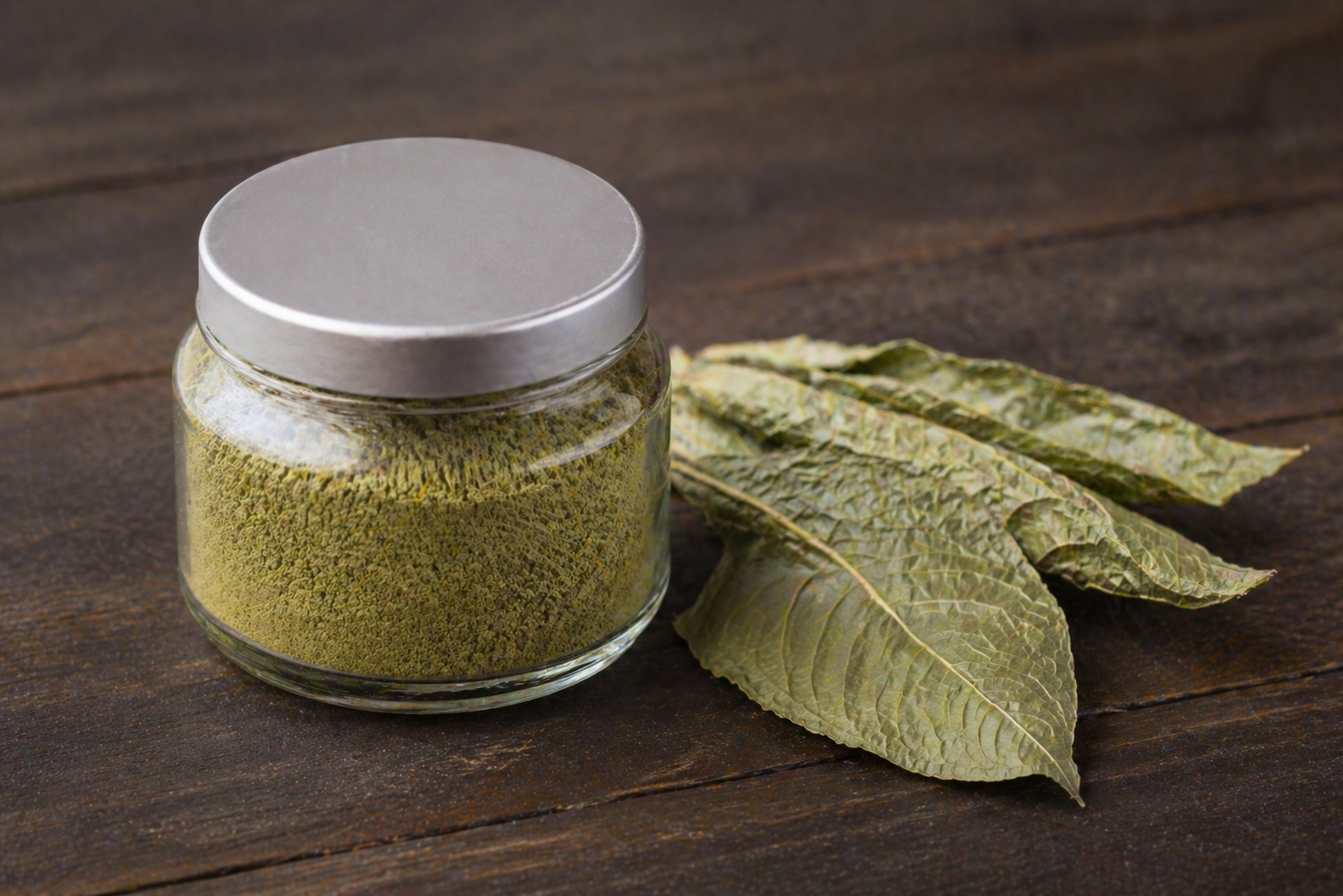
Kratom powder in airtight packaging with dried leaves — correct storage of material
Related Articles from the Edabea Blog
- Kratom: complete guide on varieties, composition, and regulation
- What is mitragynine: composition, structure, and mechanism of action
- How to grow kratom from seeds
- Kratom: the international regulatory debate
- Kratom: another plant to punish
Frequently Asked Questions about Kratom Processing
Does vein color depend on the plant or processing?
Mainly on processing. All commercial veins — red, green, white, and yellow — come from the same botanical species (Mitragyna speciosa). The color differences are the result of the drying method, the duration of the process, and, in some cases, controlled fermentation applied after harvesting. The plant's genetics has less influence on the commercial classification by veins than the post-harvest process.
What is the difference between powder and cut leaf?
The difference is in granularity and surface area. The fine powder has a larger exposed surface area, favoring the extraction of alkaloids in infusion but also oxidation during storage. The cut leaf preserves larger fragments, with a smaller surface area exposed to air and a potentially slower degradation during storage. Both formats contain the same alkaloids — the difference is in the physical process, not in chemical composition.
Is fermentation always the origin of yellow vein?
Not necessarily. The term "yellow vein" groups materials of different origins: some come from controlled fermentation, others from prolonged curing, and others from mixtures of different veins. There is no standard industry definition for yellow vein — it is a commercial term whose elaboration varies among producers.
Why does the concentration of mitragynine vary among batches from the same origin?
Because the concentration of mitragynine in Mitragyna speciosa leaves depends on multiple variable factors: the leaf's age at harvest, the climatic conditions of the season, the exact timing within the harvesting season, and variations in the drying process among producers or between batches from the same producer. This inherent variability is why batch analysis is the only reliable method to know the actual alkaloid profile of a specific material.
Article crafted by the specialized team at Edabea Natura. The phytochemical information is based on referenced bibliographic sources and analytical data from batch 22,885. Last update: April 2026.
Bibliographic References
- Shellard, E.J. et al. (1978). The Mitragyna species of Asia. Planta Medica, 34(3), 253–263.
- Veltri, C. & Grundmann, O. (2019). Current perspectives on the impact of Kratom use. Substance Abuse and Rehabilitation, 10, 23–35.
Share this content