
Shopping Cart
There are no more items in your cart

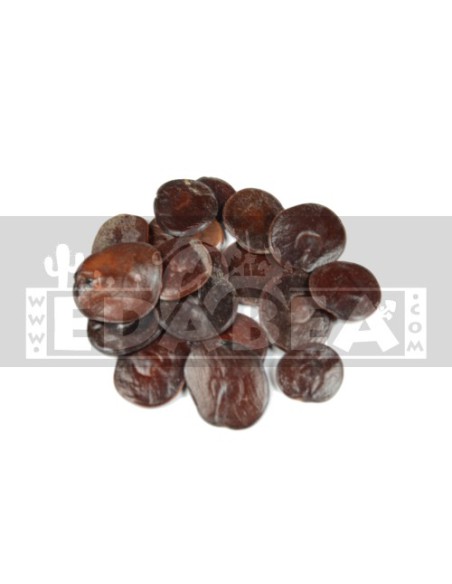
Anadenanthera Peregrina "Yopo" (10 grams)
€9.50
Tax included
Yopo (Anadenanthera peregrina) — 10 g of botanical collection seeds. South American tree belonging to the Fabaceae family with one of the oldest documented ethnobotanical histories in South America. Its seeds contain tryptamine alkaloids — DMT and bufotenin — documented in the scientific literature. Ceremonial use recorded in indigenous cultures of the Orinoco and Caribbean since pre-Columbian times. Botanical collection and ethnobotanical research material.
What is Yopo
Yopo is the common name for Anadenanthera peregrina, a medium-large tree from the Fabaceae family, native to the tropical savannas of South America. It is primarily distributed in Venezuela, Colombia, Brazil, Peru, and the Caribbean islands, where it grows in open savanna areas, forest edges, and riverbanks.
This species is closely related to Anadenanthera colubrina (Cebil), with which it shares a similar phytochemical profile. Its seeds contain tryptamine alkaloids — mainly bufotenin and DMT (N,N-dimethyltryptamine) — compounds documented in numerous scientific literature publications.
Botanical Description
Anadenanthera peregrina is a deciduous tree that can reach heights of 10 to 20 meters in its natural habitat. It features dark, cracked bark, bipinnate leaves composed of numerous small leaflets, and flowers grouped into very aromatic white-cream spherical clusters. Its fruits are flattened, curved pods that are dark brown and contain between 6 and 12 disc-shaped, smooth, and shiny seeds.
This species is a fast grower adapted to tropical and subtropical climates, with some tolerance to seasonal drought. Germination of its seeds requires prior soaking in warm water for 24 hours and a moist, well-draining substrate. The process can take several weeks.
Ethnobotanical Context
Yopo has one of the oldest documented ceremonial use histories in South America. The earliest written references to its use come from Spanish chroniclers of the 16th century, who described its use in inhaled snuff form among the indigenous peoples of the Antilles and the Orinoco basins.
Its use is particularly documented among the Piaroa, Yanomami, and Guahibo peoples of Venezuela and Colombia, where the powdered roasted seeds were prepared mixed with ash or lime and administered through tubes in shamanic and ceremonial contexts. This practice is recorded in reference ethnobotanical literature, including the works of botanist Richard Evans Schultes and ethnologist Johannes Wilbert.
In archaeology in northern Chile and northwestern Argentina, snuff tablets, inhalation tubes, and remains of Anadenanthera seeds have been found in funerary and ritual contexts dating back over 2,500 years, confirming the ancient use of these species in the Andean region.
This species is botanically related to Anadenanthera colubrina (Cebil), sharing partial geographic distribution and phytochemical profile, although its main distribution area is concentrated in the northern savannas of South America and the Caribbean, while Cebil predominates in the Andean region and the Chaco.
Format and Presentation
This product includes 10 g of Yopo seeds (Anadenanthera peregrina) for botanical collection and ethnobotanical research.
Conservation
Store in a cool, dry place protected from direct light, in a well-sealed container. Under these conditions, the seeds maintain their stability over an extended period.
Legal Aspects
The seeds of Anadenanthera peregrina are not included in the lists of controlled substances in Spain or in most countries of the European Union. However, the legal situation may vary by jurisdiction. It is the buyer's responsibility to inform themselves about the applicable regulations in their place of residence before making any order.
This product is marketed exclusively as botanical collection and ethnobotanical research material.
Frequently Asked Questions
What is the difference between Yopo and Cebil?
Anadenanthera peregrina (Yopo) and Anadenanthera colubrina (Cebil) are two species of the same genus with similar phytochemical profiles. Yopo is more prevalent in the traditions of the peoples of the Orinoco and the Caribbean, while Cebil is more associated with the Andean cultures of northwestern Argentina and Bolivia. Both species contain bufotenin and DMT in their seeds.
What is the geographical origin of Yopo?
It is native to the tropical savannas of Venezuela, Colombia, Brazil, and Peru, also present in the Caribbean islands. It prefers to grow in open savanna areas, forest edges, and riverbanks in tropical and subtropical climates.
What are bufotenin and DMT?
They are tryptamine alkaloids naturally present in the seeds of Anadenanthera peregrina and other plants. They are extensively documented in the scientific literature specialized in phytochemistry and ethnopharmacology.
Is it legal to buy Yopo seeds in Spain?
The seeds of Anadenanthera peregrina are not included in the lists of controlled substances in Spain or in most countries of the European Union. It is recommended to check local regulations before purchasing.
5 Items
Tap to zoom
