

Shopping Cart
There are no more items in your cart
Kratom: on the brink of prohibition | EDABEA
Categories :
Kratom
Kratom: the international regulatory debate on Mitragyna speciosa
Kratom has been at the center of an intense international regulatory debate for years. This traditional plant from Southeast Asia, scientifically known as Mitragyna speciosa Korth. Havil. (Rubiaceae), has evolved from a local ethnobotanical resource to a topic of discussion in regulatory agencies, scientific institutions, and consumer associations. For a comprehensive view of its varieties, alkaloid composition, and historical context, we recommend consulting our complete guide to kratom.
Etnobotanical and historical context
Kratom or Mitragyna speciosa is a tropical tree from the Rubiaceae family — the same botanical family as coffee (Coffea) — native to the humid regions of Southeast Asia. For generations, it was used in Thailand, Malaysia, and Indonesia, primarily by chewing fresh leaves or preparing infusions. In Thailand, traditional use led to prohibition under the Kratom Act of 1943, which was reversed in 2021 when the country removed the plant from its list of controlled substances. It is currently marketed mainly in powder or standardized extract form.
 Green leaf of Mitragyna speciosa. Author: ThorPorre, Wikipedia.
The DEA's decision and the regulatory debate in the United States
In August 2016, the U.S. Drug Enforcement Administration (DEA) announced its intention to temporarily place the main kratom alkaloids — mitragynine and 7-hydroxymitragynine — into Schedule I of controlled substances, the same category as heroin or LSD. This move generated a significant response: thousands of citizens submitted public comments against it, and several members of Congress urged the DEA to withdraw the proposal to allow for adequate scientific review. In October 2016, the DEA withdrew the emergency classification notice, initiating a public review process.
Russ Baer, a DEA spokesperson, stated that kratom consumption posed a health concern, especially in combination with other substances. The American Kratom Association (AKA) responded that the measure was disproportionate and did not adequately reflect the scientific evidence available about the plant.
An analysis by the Transnational Institute (TNI) noted that reported adverse effects in users include nausea, dizziness, and gastrointestinal discomfort, while documented traditional uses include its role as a mild stimulant during agricultural work and as a modulator of physical discomfort.
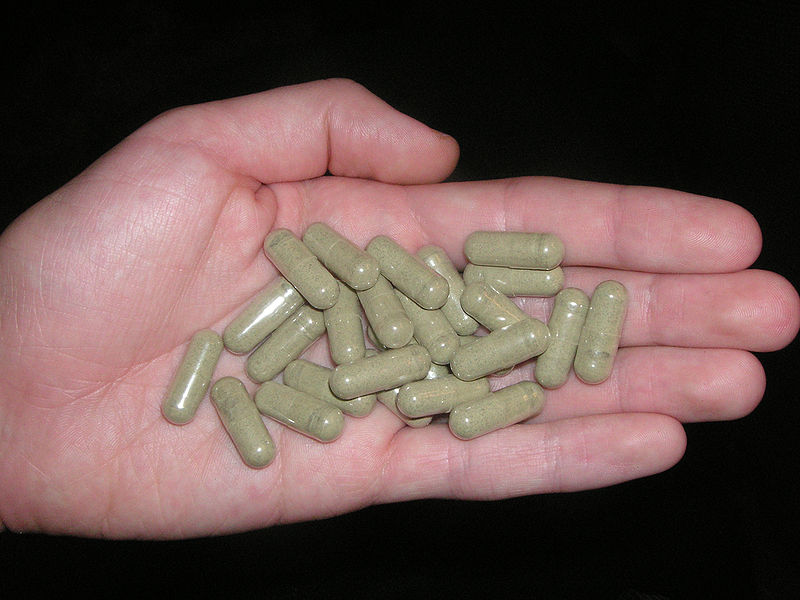 Mitragyna speciosa in capsule form. Author: Psychonaught, Wikipedia.
Safety, ceiling effect, and toxicological controversies
One of the most debated points has been the possibility of fatal overdose. Some official statements mentioned cases of death associated with kratom use between 2014 and 2016, although consumer associations argued that in virtually all documented cases, other substances — opioids, benzodiazepines, or others — were present, making it difficult to attribute causality solely to kratom.
Susan Ash, director of the AKA, argued that kratom interacts with brain receptors in such a way that increases in dosage do not produce proportional increases in effect. This argument has a documented pharmacological basis: mitragynine acts as a partial agonist of mu-opioid receptors — not as a full agonist like morphine or oxycodone. Partial agonists have an intrinsic ceiling effect: above a certain concentration, increasing the dose does not produce greater receptor activation, unlike full agonists (Matsumoto, K. et al., 2004. Life Sciences, 74(17), 2143–2155). This does not imply an absence of risks, but it does indicate a pharmacological profile distinct from that of classic opioids.
The risks of physical dependence with prolonged use are documented in the literature, with withdrawal syndrome of lesser intensity compared to classic opioids but with comparable characteristics. The scientific debate over the benefit-risk balance of kratom remains open, and regulation varies significantly by country.
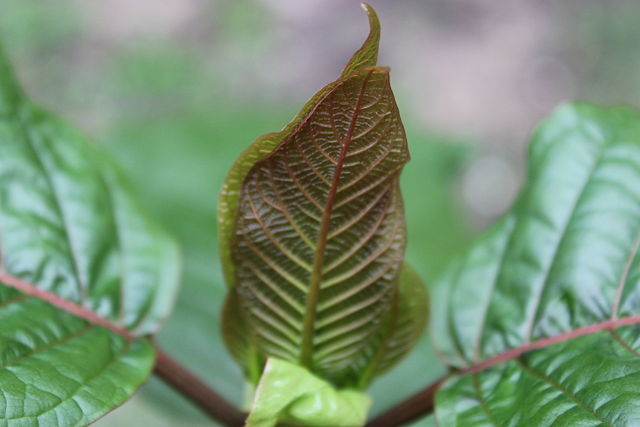 Leaf of Mitragyna speciosa. Author: ThorPorre, Wikipedia.
Current research lines
In addition to its traditional use, there are currently research lines studying kratom's role in harm reduction strategies — particularly as a supervised alternative in the context of opioid dependency — and in chronic pain treatment. These investigations are preliminary and have not yet produced results that allow for established clinical recommendations. The FDA has not approved any therapeutic use of kratom.
If you would like to know the different varieties available and their alkaloid composition, you can visit our section on kratom.
Legal status of kratom in 2026
The legality of kratom varies by jurisdiction and may change. Thailand legalized the plant in 2021. In most European countries, kratom is not classified as a controlled substance, although some member states have established national restrictions. In the United States, the situation varies by state. It is the buyer's responsibility to verify the applicable regulations in their place of residence before purchasing. Edabea products are marketed exclusively as botanical collection material and ethnobotanical research.
Frequently asked questions about the kratom regulatory debate
Why did the DEA attempt to prohibit kratom in 2016?
The DEA cited health concerns arising from reported death cases involving kratom and its action mechanism on opioid receptors. In August 2016, it announced the intention to classify mitragynine and 7-OH in the emergency Schedule I. After a significant public response — including citizen petitions and congressional pressure — it withdrew the notice in October 2016 to initiate a formal scientific review. As of the date of this article, kratom is not classified as Schedule I at the federal level in the United States.
What difference is there between kratom and classic opioids from a pharmacological perspective?
Classic opioids such as morphine are full agonists of mu receptors — they produce maximum receptor activation even at low doses, and the effect continues to increase with the dose until toxic limits. Mitragynine, the major alkaloid in kratom, acts as a partial agonist — producing submaximal receptor activation with an intrinsic ceiling effect. Additionally, paynantheine and speciogynine — other kratom alkaloids — act as mu antagonists, further modulating the response. This pharmacological difference is the basis for the argument of lower direct overdose risk, although it does not imply an absence of physical dependence with prolonged use.
Does kratom cause dependence?
Yes — physical dependence with prolonged use is documented in scientific literature, with a withdrawal syndrome that includes irritability, insomnia, muscle pain, and other symptoms similar to opioid withdrawal syndrome, although of lesser intensity in most reported cases. Psychological dependence is also documented. These risks are part of the international regulatory debate surrounding kratom.
Is kratom approved as a drug?
No — kratom is not approved as a medication in any major jurisdiction. In the European Union and the United States, its marketing falls under other regulatory categories. Current research lines are preliminary and have not produced results that allow for established clinical recommendations.
About this content
Original article by Germán Carrera. Reviewed and updated by the Edabea team with regulatory information updated to April 2026. The pharmacological information is based on the cited bibliographic sources.
Bibliographic references
- Matsumoto, K. et al. (2004). Central antinociceptive effects of mitragynine in mice. Life Sciences, 74(17), 2143–2155.
- Veltri, C. & Grundmann, O. (2019). Current perspectives on the impact of Kratom use. Substance Abuse and Rehabilitation, 10, 23–35.
Share this content
