Shopping Cart
There are no more items in your cart

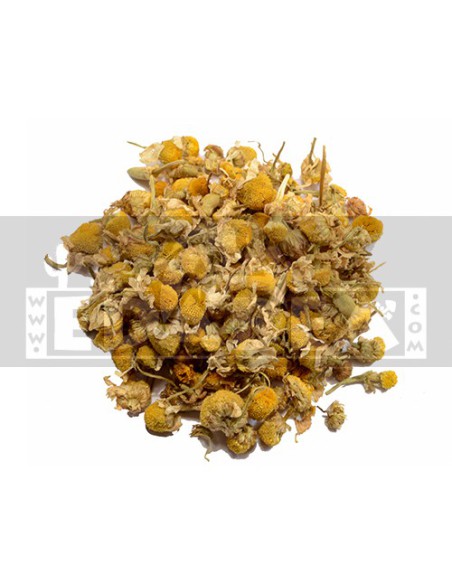
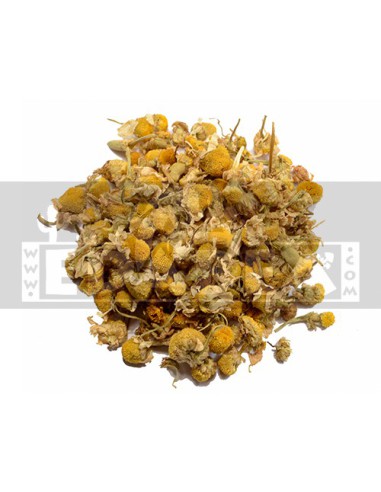
German Chamomile 100 g
Last items in stock
€8.30
Tax included
German Chamomile (Matricaria chamomilla, syn. Chamomilla recutita) — whole dried flowers, 100 g. Annual herbaceous plant from the Asteraceae family, documented in Egyptian, Greek, and Roman pharmacopoeias. Its flowers contain essential oil rich in azulene (chamazulene), a deep blue compound that is not present in the fresh plant. Botanical collection material.
Ratings and comments from our customers
Chamomile — product information
German Chamomile (Matricaria chamomilla, syn. Chamomilla recutita) is an annual herbaceous plant from the Asteraceae family, native to Eastern Europe and Western Asia, now naturalized across Europe and temperate regions of America. It is available in whole dried flowers of 100 g. It is one of the most consumed herbal plants in the world and one of the most documented in the history of medicine.
Etymology and history
The name chamomilla comes from the Greek chamaimelon — "earth apple" — referring to the sweet, fruity aroma of the flowers, similar to that of an apple. The epithet recutita means "with the bark removed" in Latin, referencing the characteristic hollow floral receptacle of this species.
Chamomile has one of the longest historical trajectories in Western herbalism. It is documented in the Ebers Papyrus (Egypt, around 1550 B.C.), one of the oldest preserved medical texts, where it is mentioned in preparations for fever. The Greeks knew it as chamaimelon and it appears in Dioscorides' writings in the 1st century A.D. The Romans widely used it, and during the Middle Ages, it was one of the most cultivated plants in European monastic gardens.
In medieval Anglo-Saxon tradition, chamomile was one of the nine sacred herbs mentioned in the Lacnunga — a 10th-century Anglo-Saxon manuscript that contains charms and herbal remedies — under the name maythen. Its continuous use over more than 3,500 documented years makes it one of the plants with the most historical continuity in Western medicine.
Botanical description
Matricaria chamomilla is an annual plant that grows between 20 and 60 cm tall, with erect, branched stems, and finely divided leaves into thread-like segments and characteristic composite flowers of the Asteraceae family — white ligulate flowers on the outside and yellow tubular flowers in the center, atop a conical and hollow receptacle. This internal cavity of the receptacle is the anatomical feature that distinguishes German chamomile from Roman chamomile (Chamaemelum nobile), whose receptacle is solid.
Azulene — the compound that is not present in the fresh plant
The most singular phytochemical feature of Matricaria chamomilla is the presence of chamazulene (azulene) in its essential oil — a deep blue compound that does not exist in the fresh plant. Chamazulene is formed during the steam distillation of the essential oil from a colorless precursor called matricin. It is this thermal transformation process — a chemical reaction that occurs during distillation — that generates the blue compound and gives chamomile essential oil its characteristic deep blue color.
The essential oil of German chamomile is one of the few blue essential oils found in nature — alongside tansy oil (Tanacetum annuum) — and this coloration is a quality and authenticity indicator used in analytical control of the product.
In addition to chamazulene, the flowers contain α-bisabolol and its oxides, flavonoids (apigenin, luteolin, quercetin), and coumarins.
German Chamomile vs. Roman Chamomile
There are two species commonly known as "chamomile" with distinct botanical and phytochemical profiles:
- German Chamomile (Matricaria chamomilla) — hollow receptacle, blue essential oil due to chamazulene, annual plant. This is the reference of this listing.
- Roman Chamomile (Chamaemelum nobile) — solid receptacle, pale yellow essential oil, perennial plant. Phytochemical profile dominated by esters such as isobutyl angelate, with lower content of chamazulene.
The European Pharmacopoeia distinguishes between both species and establishes independent analytical specifications for each.
Conservation
Store in a cool, dry place protected from direct light, in an airtight container. The dried chamomile flowers are rich in volatile essential oil — seal the container well after each opening to preserve the characteristic aroma.
Legal aspects
Matricaria chamomilla is completely legal with no regulatory restrictions. The legal status may vary by jurisdiction. This product is marketed exclusively as botanical collection material.
Frequently Asked Questions
Why is chamomile essential oil blue if the flower is white and yellow?
The blue color of German chamomile essential oil is due to chamazulene, a compound that does not exist in the fresh plant — it forms during steam distillation from matricin, a colorless precursor present in the flowers. It is a thermal chemical reaction that transforms the precursor into the blue compound during the extraction process. This intense blue color is an indicator of authenticity and quality of German chamomile essential oil.
What is the Ebers Papyrus?
The Ebers Papyrus is one of the oldest preserved medical texts, dating to approximately 1550 B.C. in Ancient Egypt. It contains over 700 prescriptions and herbal remedies and is a fundamental source of knowledge regarding ancient Egyptian medicine. It was acquired by the German Egyptologist Georg Ebers in Luxor in 1872 and is preserved in the Library of the University of Leipzig, where it remains today. Chamomile is mentioned in this papyrus in preparations for fever, making it one of the oldest documented plants used in the history of Western medicine.
What is the difference between the chamomile in this listing and common Spanish chamomile?
In Spain, the term "chamomile" may refer to several different plants depending on the region. The chamomile most commonly consumed in Spain as an infusion is typically Matricaria chamomilla (German chamomile) or Chamaemelum nobile (Roman chamomile). There is also "Mahón chamomile" (Santolina chamaecyparissus) and other local species with similar names. This listing corresponds to Matricaria chamomilla — the species most documented in the European pharmacopoeia and the most widely used in the herbal industry worldwide.
1 Item
Tap to zoom