Shopping Cart
There are no more items in your cart
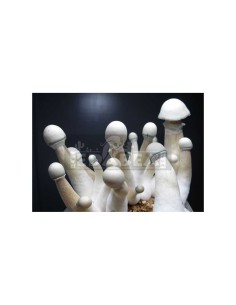
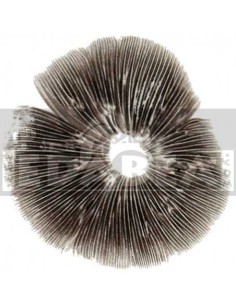

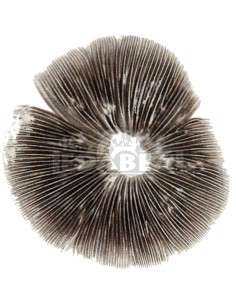


Spore prints — also known as spore prints — are natural impressions obtained from the deposit of spores of Psilocybe cubensis onto sterile paper. They are one of the most traditional formats in mycology, microscopic observation, and scientific collection, with a long history documented in mycological literature. The spores of Psilocybe cubensis do not contain psilocybin or psilocin — these compounds are synthesized only during the mushroom's development, not in the spore. We offer 25 distinct strains in print format.
A spore print is the impression left by the mature cap of a mushroom as it releases its spores onto sterile paper for several hours. The result is a visible pattern containing millions of dry microscopic spores, with the characteristic radial distribution of the gills of the fruiting body. This classic method in mycology allows for the study of spore morphology under a microscope, analysis of the spore deposit color as a taxonomical tool — in Psilocybe cubensis the spores are dark purple-brown — and the preservation of samples in a stable and compact format for prolonged periods.
Unlike suspension vials, the spore print does not require refrigeration and is the preferred format for long-term preservation and observation of the complete spore print.
Central America and Mexico
South America
North America
Asia and Pacific
Africa
Selected strains and proprietary names
All three formats contain spores of Psilocybe cubensis for mycological study, but differ in support, preservation, and use:
| Format | Support | Preservation | Main Use |
|---|---|---|---|
| Spore Print | Sterile paper (dry) | Cool, dark place, no refrigeration | Observation of spore print, long-term preservation |
| Spore Vial | Sterile saline suspension | Refrigerator 2-8°C | Microscopic observation, direct inoculation |
| Spore Swab | Sterile swab stick | Cool, dry place | Controlled handling in laboratory environment |
Spore prints should be stored in a dry, dark place at a stable room temperature. They do not require refrigeration but should be kept away from moisture — the main cause of deterioration. Do not handle the printed surface directly. Store in its original packaging until ready for study.
Spores of Psilocybe cubensis do not contain psilocybin or psilocin. The legal situation varies by jurisdiction. It is the buyer's responsibility to verify applicable regulations in their area before placing an order. This product is marketed exclusively as material for mycological study and microscopic observation.
The color of the spore deposit is one of the most important taxonomical characteristics in mycology. In Psilocybe cubensis, the spores are dark purple-brown, nearly black in dense deposits. This color is consistent within the species and allows it to be distinguished from other species in the genus or superficially similar fungi. The complete spore print — showing the radial distribution of the gills — is a classic identification tool in field and laboratory mycology.
Dry spores on sterile paper are metabolically inactive and do not require special temperature conditions to maintain viability. Under appropriate conditions of low humidity and darkness, they can be preserved for years or decades — significantly longer than a liquid suspension. This is why herbariums and scientific mycological collections traditionally use the spore print format for sample archiving.
This is one of the most common confusions in the mycological market — both species share the same popular name. Panaeolus cyanescens is a distinct species from Psilocybe cubensis, with different morphology, habitat, and alkaloid profiles. The Blue Meanie prints available at Edabea correspond to Psilocybe cubensis, not Panaeolus cyanescens.
Edabea offers 25 distinct strains in spore print format, organized by geographic origin — America, Asia, Pacific, and Africa — and by proprietary names. You can also check the strains available in spore vials and hybrid spore swabs.
Feedbacks
Category : Spore Prints
Based on 2 feedback(s) 2